Method
Tap a time to start a timer.
Put the cottage cheese and egg in a blender and blend until completely smooth.
Tip the blended mixture into a large bowl. Add the self-raising flour and vital wheat gluten and mix with a spoon until a sticky dough forms. Turn it out onto a surface dusted with some of the plain flour and knead until smooth and slightly tacky.
Cover the dough with the upturned bowl and leave it to rest. Meanwhile, heat the oven to 200°C (180°C fan), gas 6, and line a large baking tray with baking parchment.
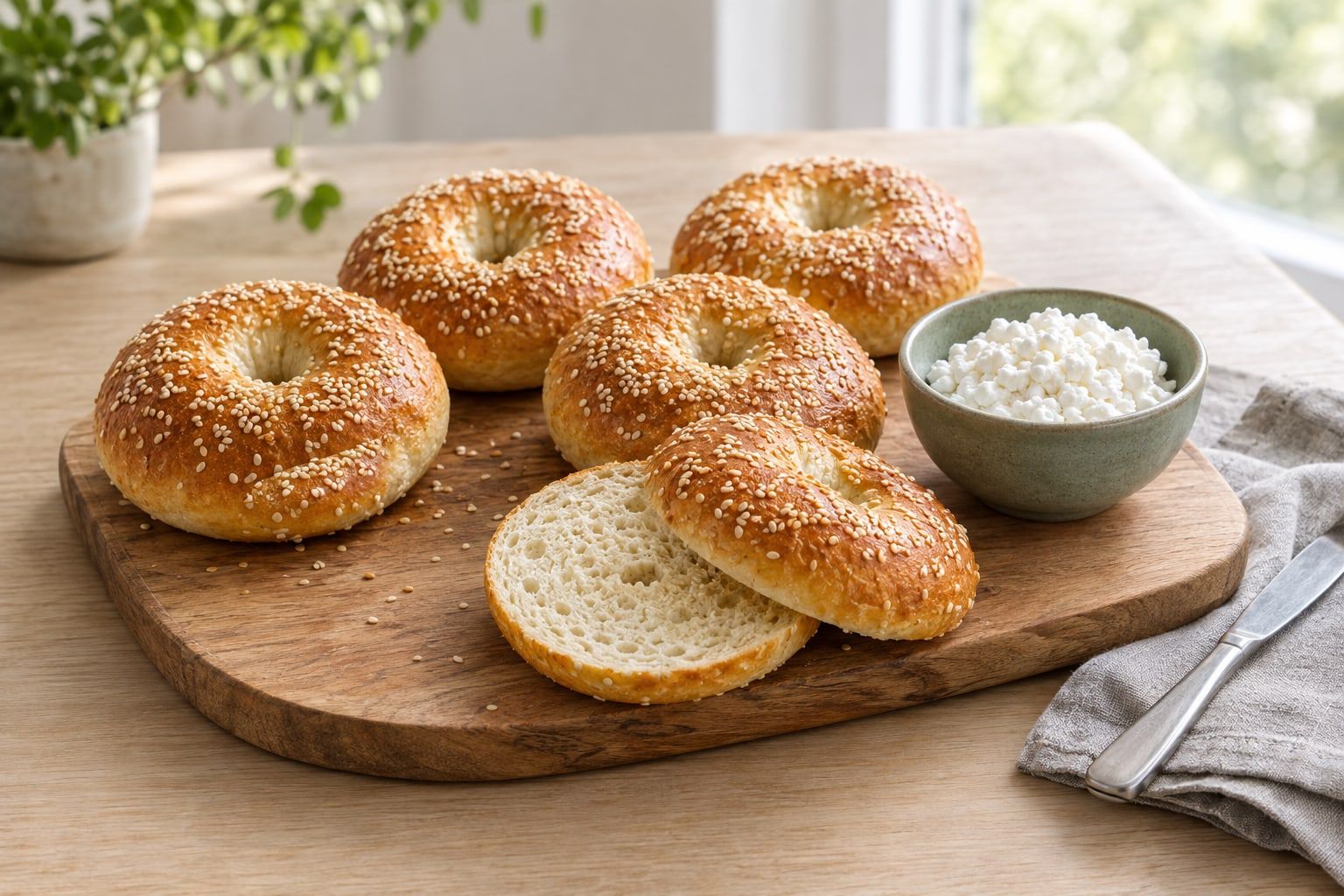
Divide the dough into 6 pieces of about 105 g. Roll each into a rope about 20 cm long, wrap it round your hand to form a ring with a hole about 3 cm across and press the ends together firmly. Place the rings on the lined tray, spaced about 3 cm apart.
Brush the tops with the milk and sprinkle with the sesame seeds. Bake on the middle shelf until deep golden brown.
Check that the centre of one bagel reads 96–98°C. Leave the bagels to cool on a wire rack for 10 minutes before cutting.
How to tell it's done
- The bagels are deep golden brown on top and the centre of one reads 96–98°C.
- A skewer pushed into the thickest part of a bagel comes out clean and dry.
Tips for success
- Blend the cottage cheese until smooth
Any curds left in the dough melt in the oven and leave small holes. Blend the cottage cheese with the egg for about 1 minute, until there are no visible lumps, before it meets the flour.
- Keep the dough tacky, not wet
The dough is sticky when it first comes together and firms up as you knead it for 5 minutes. Dust the work surface with a little flour rather than working more into the dough, which makes the bagels dry.
- Make the hole bigger than you think
A 3 cm hole closes up to about 1.5 cm as the bagels rise in the oven. Push the shaped rings out gently with your fingers before they go on the tray.
Boost the protein
- Replace 30 g of the self-raising flour with another 30 g vital wheat gluten: +3 g protein per bagel, with a chewier crumb.
- Spread each baked bagel with 50 g reduced fat cottage cheese: +5 g protein per bagel.
Choosing ingredients
Use plain reduced fat cottage cheese with about 10.6 g protein per 100 g. A small-curd tub blends the fastest.
Vital wheat gluten is sold in the baking aisle and online. It is the reason these bagels are chewy, so do not leave it out. The bagels are not suitable for anyone avoiding gluten.
Variations
- Mini bagels
Divide the dough into 12 pieces of about 52 g and shape into 8 cm rings. Bake for 15–18 minutes. Each mini bagel has about 7 g protein, so eat two.
- Cheese-topped bagels
Press 30 g grated half-fat Cheddar onto the milk-brushed tops of the six rings before baking, instead of the sesame seeds. Protein rises by about 1.5 g per bagel.
Serve it with
- Scrambled eggs
- Smoked salmon and cucumber
- Cottage cheese with sliced tomato and black pepper
Storage
Keep the cooled bagels in an airtight container at room temperature for 1–2 days.
Freeze them for up to 1 month, sliced if you like, and toast from frozen.
Troubleshooting
Why are my cottage cheese bagels dense and heavy?
The dough probably contained too much gluten or was over-floured while kneading. Weigh the vital wheat gluten at exactly 30 g, dust the surface lightly and knead for no longer than 5 minutes.
Why did the holes in my cottage cheese bagels close up?
The hole was too small when shaped. Make the hole about 3 cm across and press the join firmly, because the dough rises in the oven and shrinks the opening by about half.
Frequently asked questions
How much protein is in these cottage cheese bagels?
Each of the six bagels has 14 g protein and 253 kcal, so 23% of the energy comes from protein. The cottage cheese, the gluten and the self-raising flour each add a similar amount.
Are these cottage cheese bagels real bagels?
They have the ring shape and chewy crumb of a bagel, but they skip the yeast, the long rise and the boiling in water. The dough is rested for just 10 minutes and the bagels are baked straight away.
What about cottage cheese on a bagel?
For the topping version, split a baked bagel and spread it with cottage cheese, tomato and black pepper. Each 50 g spoonful of reduced fat cottage cheese adds about 5 g protein, and cottage cheese toast uses the same idea on bread.
Can I make cottage cheese bagels without vital wheat gluten?
Without it, the bagels are softer and more like a scone, with about 3 g less protein each. Use 330 g self-raising flour in total and no gluten, and expect a less chewy crumb.
Made it? Rate the recipe
Read next
- Protein in Cottage CheeseProtein in cottage cheese: 150 g plain has 14.1 g protein and 155 kcal, reduced fat has 15.9 g and 102 kcal. Values per 100 g, per portion and per tub.
- Protein in BreadProtein in bread: a slice has 2.8–4.0 g protein depending on type and weight. Wholemeal, white, seeded, bagels, pitta and tortillas compared.
- Highest Protein CheeseProtein in cheese per 100 g and per portion: Parmesan has 36.2 g, half-fat Cheddar 32.7 g and feta 15.6 g. Ranked by protein and per 100 kcal.
Written by The Protein Recipes editorial team. Nutrition is calculated from the ingredient list using CoFID. Read how our recipes are made and how we correct mistakes.