Method
Tap a time to start a timer.
Heat the oven to 160°C (140°C fan), gas 3. Line the base of the springform tin with baking parchment.
Blitz the oats in the blender to a coarse crumb and tip into a bowl. Stir in the melted butter and honey and press the mixture firmly into the base of the tin. Bake on the middle shelf until lightly set, then take it out and leave the oven on.
Wipe out the blender jug. Blend the cottage cheese for 2 minutes, scraping down the sides once, until completely smooth. Add the quark, eggs, sweetener, lemon juice and vanilla extract and blend until combined.
Pour the filling onto the warm oat base, level it with a spatula and bang the tin gently on the worktop to knock out air bubbles. Return it to the middle shelf and bake until the edge has set.
Turn the oven off and let the cheesecake cool inside, with the door shut.
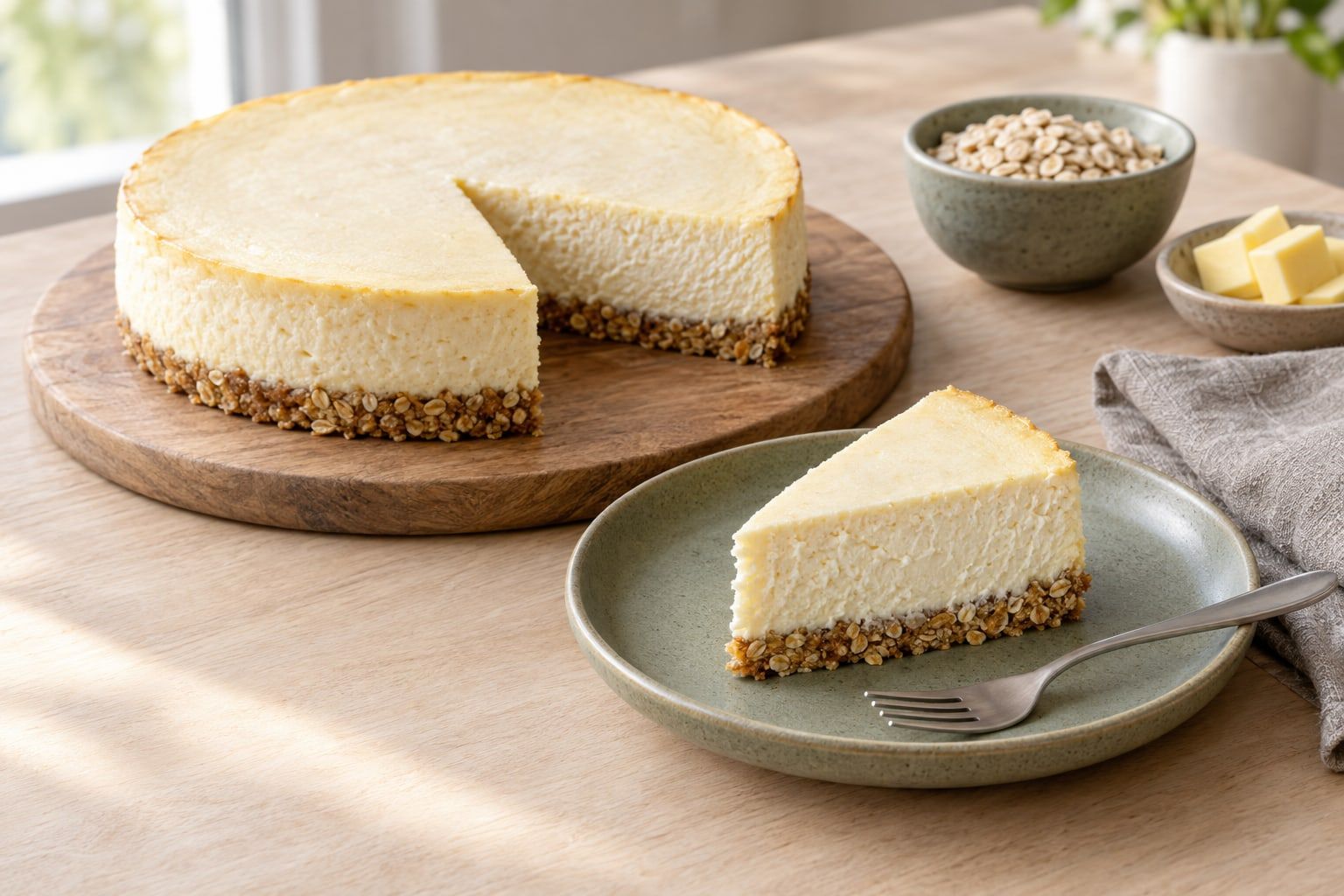
Loosen the edge with a knife, cover the tin with cling film and put it in the fridge for at least 4 hours or overnight. Release the tin and cut into 8 slices.
How to tell it's done
- The outer 4 cm is firm, and only the very middle trembles when you give the tin a gentle nudge.
- The top is an even pale cream colour, without browned spots or splits.
Tips for success
- Blend the cottage cheese for 2 minutes
Cottage cheese curds make the filling grainy unless they are broken down completely. Blend for 2 minutes, stop to scrape down the jug and blend again until the mixture is as smooth as double cream.
- Keep the oven low
A gentle 160°C (140°C fan) lets the eggs set slowly. Higher heat inflates the filling and the surface splits when it deflates.
- Cool it slowly in the oven
Once the bake is done, switch the oven off and keep the door closed for 1 hour. Falling slowly in temperature keeps the top intact. Then chill for at least 4 hours before releasing the tin.
Boost the protein
- Use 500 g quark instead of 250 g, adding 250 g to the filling and baking for 5 minutes longer: +5 g protein per slice.
- Top each slice with 30 g strained 0% fat Greek yogurt: +3 g protein per slice.
Choosing ingredients
Use plain reduced fat cottage cheese, which has 10.6 g protein per 100 g. Full-fat cottage cheese has less protein and adds fat.
Quark is sold in 250 g tubs, so one tub is the right amount. If liquid has gathered on top in the tub, pour it off before weighing.
Variations
- Raspberry swirl cottage cheese cheesecake
Mash 100 g raspberries with a fork and swirl them over the filling with a skewer before baking. Bake for the same 40–45 minutes.
- Lemon cottage cheese cheesecake
Add the finely grated zest of 1 lemon and 2 tbsp lemon juice in place of the 1 tbsp in step 3. Bake for the full 45 minutes, because the filling is a little looser.
Serve it with
- Stewed rhubarb
- Sliced strawberries
- A pot of Earl Grey
Storage
Store the whole cheesecake, loosely covered, on a shelf in the fridge. It stays at its best for up to 3 days because of the eggs and cottage cheese.
Wrap cut slices one by one and freeze for up to 1 month. Defrost on a plate in the fridge overnight.
Troubleshooting
Why is my cottage cheese cheesecake grainy?
The cottage cheese was not blended smooth. Blend it alone for the full 2 minutes in step 3, scraping the jug, before adding the quark and eggs.
Why did the cottage cheese cheesecake crack on top?
Heat shock does it. A hot oven or a sudden drop in temperature pulls the surface apart. Stay at 160°C (140°C fan), and give the cheesecake the full hour in the closed, switched-off oven before it goes anywhere cold.
Frequently asked questions
How much protein is in this cottage cheese cheesecake?
Each of the 8 slices has 15 g protein and 164 kcal, so 36% of the energy comes from protein. Cottage cheese gives about 7 g per slice, the quark 5 g and the eggs 2 g.
Can you use cottage cheese in a cheesecake?
Yes, as long as it is blended completely smooth. Cottage cheese replaces the cream cheese that a classic baked cheesecake uses, with far less fat and a lot more protein.
Does cottage cheese cheesecake taste like cottage cheese?
Blended and baked with eggs, honey and lemon, it tastes mild, creamy and slightly tangy, like a lighter version of a classic baked cheesecake. The texture is smooth rather than curdy.
Can I make cottage cheese cheesecake without eggs?
The eggs are what set the filling, so leaving them out gives a soft, mousse-like dessert that needs a longer chill and will not hold clean slices. Keep the three eggs for a baked cheesecake.
Made it? Rate the recipe
Read next
- Protein in Cottage CheeseProtein in cottage cheese: 150 g plain has 14.1 g protein and 155 kcal, reduced fat has 15.9 g and 102 kcal. Values per 100 g, per portion and per tub.
- Highest Protein CheeseProtein in cheese per 100 g and per portion: Parmesan has 36.2 g, half-fat Cheddar 32.7 g and feta 15.6 g. Ranked by protein and per 100 kcal.
Written by The Protein Recipes editorial team. Nutrition is calculated from the ingredient list using CoFID. Read how our recipes are made and how we correct mistakes.