Method
Tap a time to start a timer.
Put the cottage cheese and milk in the blender and blend on high until completely smooth.
Stop the blender and scrape down the sides with a spatula. Add the cocoa powder, honey and vanilla extract and blend again until glossy and evenly dark.
Taste the mousse and blend in a little more honey if you want it sweeter.
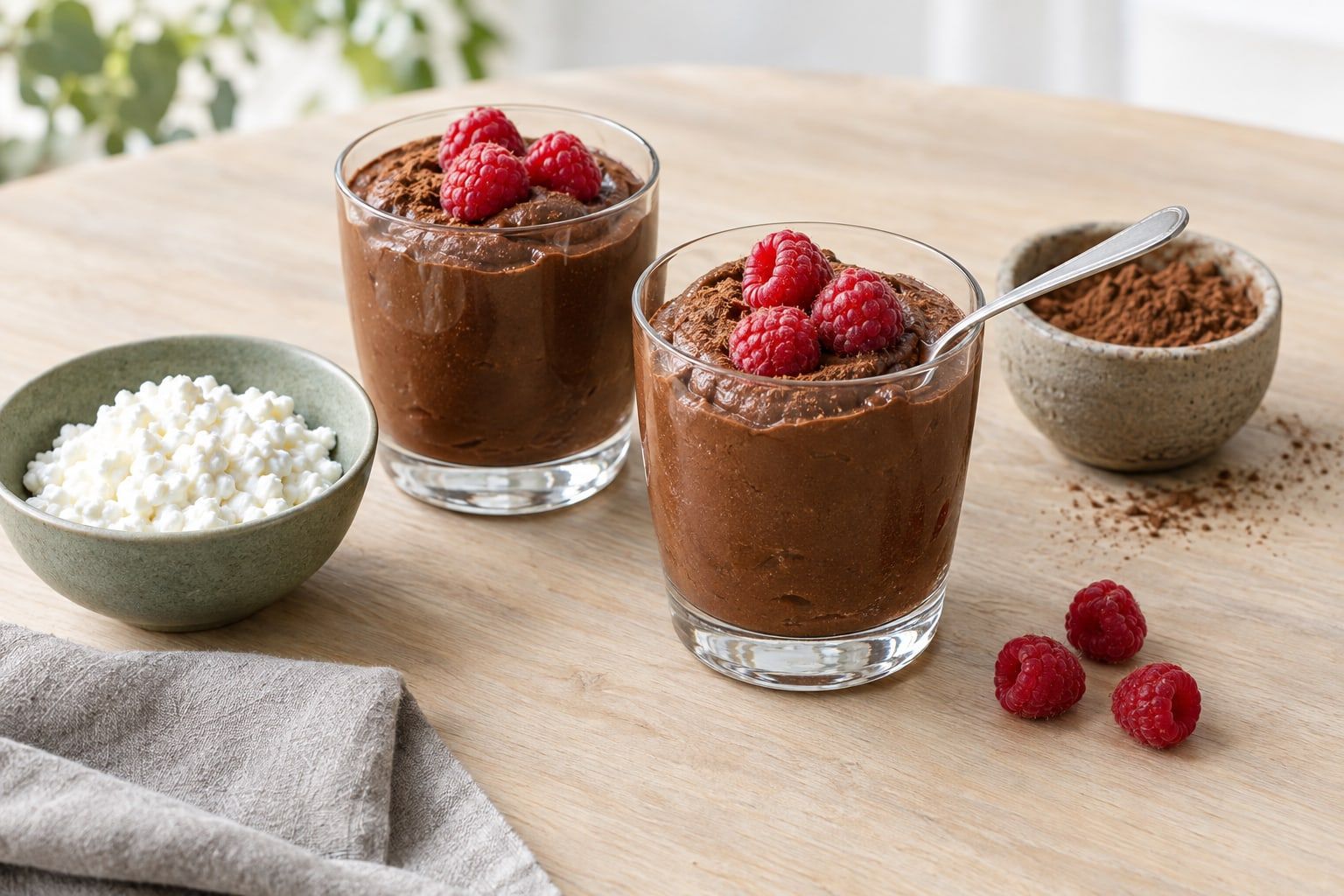
Spoon the mousse into 2 glasses or ramekins, cover with cling film and chill until set. Top with the raspberries just before serving.
How to tell it's done
- The mousse is completely smooth, with no visible curds when you lift a spoonful.
- After chilling, it holds its shape on a spoon in a soft mound.
Tips for success
- Blend, scrape, blend again
Blend the cottage cheese and milk for a full 2 minutes, then stop, scrape the sides and blend for another 30 seconds. Curds that cling to the walls of the jug are the main cause of a grainy mousse.
- Taste before it chills
Cocoa powder is unsweetened and chilling dulls sweetness slightly. Taste the mousse after step 3 and add 1 tsp more honey at a time, blending for 10 seconds after each, until it suits you.
- Chill for at least 30 minutes
Straight from the blender the mousse is the texture of a thick sauce. After 30 minutes in the fridge it sets to a soft, spoonable mousse, and 1 hour gives it a firmer finish.
Boost the protein
- Replace the 50 ml milk with 50 g quark: +3 g protein per serving.
- Use 400 g cottage cheese instead of 300 g: +5 g protein per serving.
Choosing ingredients
Use plain reduced fat cottage cheese, with about 10.6 g protein per 100 g. A small-curd tub gives the smoothest mousse.
Use unsweetened cocoa powder, not drinking chocolate, which is mostly sugar. Sift it if it has lumps, so that it blends in evenly.
Variations
- Lower-sugar mousse
Use 20 g granulated sweetener in place of the honey. The mousse has about 150 kcal per serving, against 193 kcal with honey, and the same protein.
- Mocha mousse
Dissolve 1 tsp instant coffee in the milk before blending in step 1. The coffee deepens the chocolate flavour and the protein stays the same.
Serve it with
- Fresh raspberries or sliced strawberries
- A crisp oat biscuit
- Black coffee
Storage
Keep the mousse covered with cling film in the fridge for up to 2 days. It firms up a little overnight.
Do not freeze it, because the cottage cheese turns grainy once thawed.
Troubleshooting
Why is my cottage cheese chocolate mousse grainy?
The cottage cheese was not blended long enough. Blend the cottage cheese and milk for the full 2 minutes in step 1, scrape the jug and blend again, since curds hide in the corners.
Why is the cottage cheese chocolate mousse bitter?
Unsweetened cocoa is bitter and the cottage cheese is only mildly sweet. Blend in 1 tsp more honey at a time until it tastes right, or use the lower-sugar variant with a little extra sweetener.
Frequently asked questions
How much protein is in this cottage cheese chocolate mousse?
Each of the 2 servings has 19 g protein and 193 kcal, so 39% of the energy comes from protein. Cottage cheese provides about 16 g, the cocoa 2 g and the milk 1 g.
Can you make mousse with cottage cheese?
Yes. Cottage cheese blends into a smooth, creamy base that behaves like the cream and egg in a classic mousse. It must be blended for a full 2 minutes or the curds stay visible.
Does cottage cheese chocolate mousse taste of cottage cheese?
Not noticeably. Cocoa, honey and vanilla cover the mild, slightly salty taste, and what you notice is a creamy, rich chocolate dessert.
Is this protein mousse made with cottage cheese suitable for the freezer?
No. It keeps for 2 days in the fridge but turns grainy when frozen and thawed, so make it fresh in small batches.
Made it? Rate the recipe
Read next
- Protein in Cottage CheeseProtein in cottage cheese: 150 g plain has 14.1 g protein and 155 kcal, reduced fat has 15.9 g and 102 kcal. Values per 100 g, per portion and per tub.
- Highest Protein CheeseProtein in cheese per 100 g and per portion: Parmesan has 36.2 g, half-fat Cheddar 32.7 g and feta 15.6 g. Ranked by protein and per 100 kcal.
Written by The Protein Recipes editorial team. Nutrition is calculated from the ingredient list using CoFID. Read how our recipes are made and how we correct mistakes.