Method
Tap a time to start a timer.
Tip the cottage cheese into a sieve and leave it to drain. Grate the Cheddar.
Crack the eggs into a bowl, add the pepper and whisk with a fork until no streaks of white remain.
Heat the rapeseed oil in a 24 cm non-stick frying pan over a medium heat. Pour in the eggs and cook, pulling the set edges towards the centre with a spatula and tilting the pan so the liquid egg runs into the gaps, until the base is set and the top is still slightly glossy.
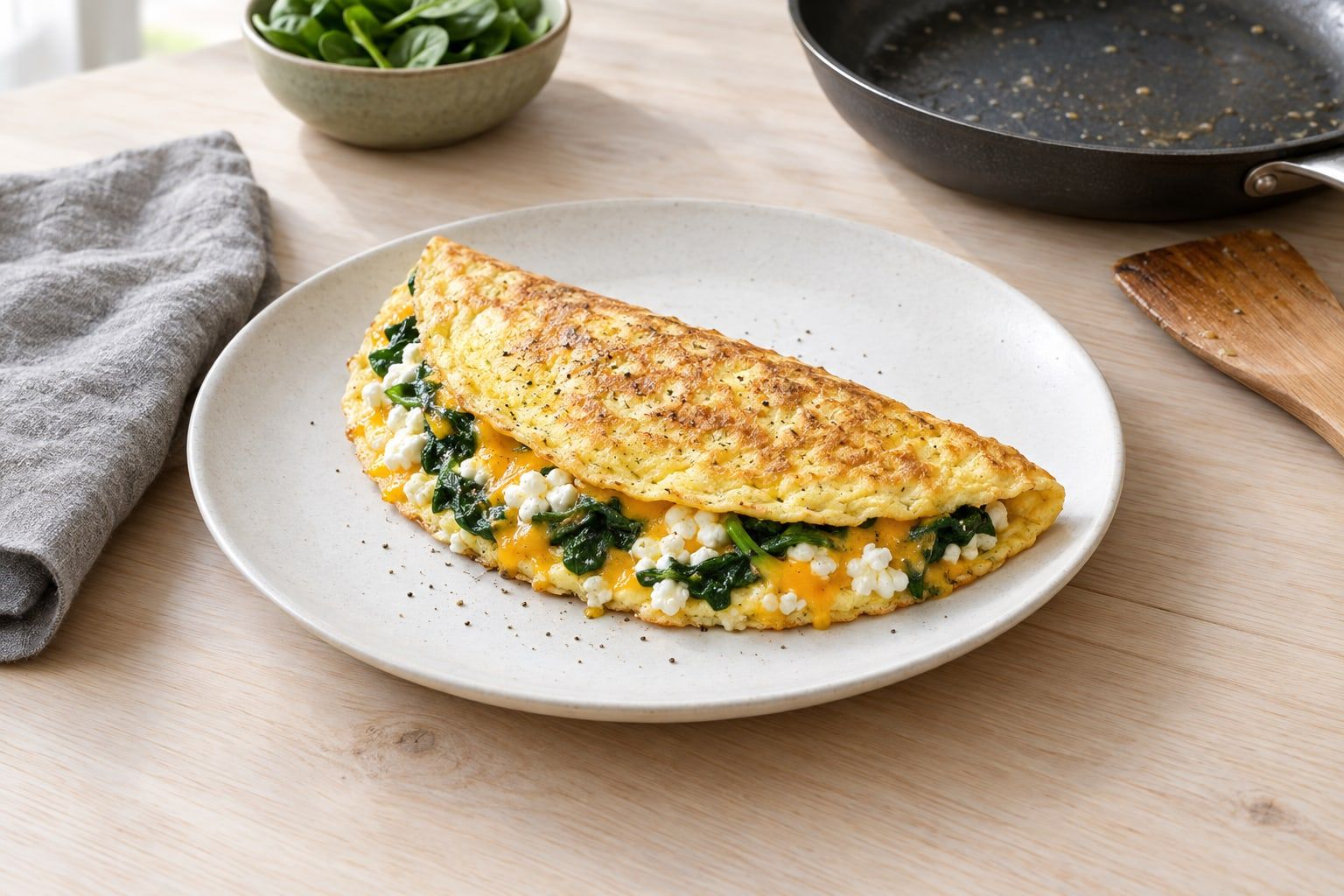
Scatter the spinach over one half of the omelette, then spoon over the cottage cheese and sprinkle with the Cheddar. Cook until the underside is lightly golden and the spinach has started to wilt.
Fold the empty half over the filling with the spatula and slide the omelette onto a plate. Eat straight away.
How to tell it's done
- Core temperature: 75°C in the thickest part, checked with a probe thermometer.
- The omelette is set all the way through with no runny egg, and the outside is pale yellow with a few golden patches.
- The Cheddar has melted into the cottage cheese and the spinach has wilted.
Tips for success
- Drain the cottage cheese first
Spoon the cottage cheese into a sieve while you whisk the eggs. The watery whey that drains off is what turns a folded omelette soggy in the middle.
- Keep the heat at medium
Over high heat the base browns and toughens before the top sets. At medium heat 3 eggs set in about 2 minutes and stay soft and pale yellow.
- Fill one half only
100 g cottage cheese, 30 g spinach and 20 g Cheddar is as much as a 24 cm omelette will hold. Spread it over one half, leaving a thin border, so the fold closes without tearing.
Boost the protein
- Whisk 2 extra egg whites (about 66 g) into the 3 eggs: +7 g protein, and the mixture still fits a 24 cm pan.
- Serve the omelette with 100 g extra cottage cheese on the side: +11 g protein.
Choosing ingredients
Use reduced fat plain cottage cheese for the best protein per 100 g (10.6 g against 9.4 g in the full fat version). A small-curd tub spreads more evenly inside the fold.
Half fat Cheddar has more protein per 100 g than regular Cheddar and melts quickly in the residual heat. A mature one needs less to taste cheesy.
Variations
- Blended and fluffy
Blend the eggs with the cottage cheese until smooth, cook the mixture for 2 minutes, cover the pan for 1 minute and fold over the spinach and Cheddar. The result is softer and rises slightly, with the same protein.
- Two-egg omelette
Use 2 eggs with the same filling in a 20 cm pan. It gives about 30 g protein and is easier to fold.
- With tomato and chives
Replace the spinach with 1 sliced medium tomato and a small handful of chopped chives. Add the tomato with the cottage cheese in step 4.
Serve it with
- Wholemeal toast
- Cherry tomatoes grilled until blistered
- Black coffee or tea
Storage
Eat the omelette straight away. The cottage cheese cools the filling and the eggs turn rubbery on reheating.
If you need to prepare ahead, whisk the eggs and keep them covered in the fridge for up to 24 hours, and drain and grate the filling separately.
Troubleshooting
Why does my cottage cheese omelette tear when I fold it?
There was too much filling or the base was cooked too long. Keep to 100 g cottage cheese, 30 g spinach and 20 g Cheddar, fill one half only and fold as soon as the top has lost its raw look.
Why is my cottage cheese omelette watery in the middle?
The cottage cheese carried extra whey into the pan. Drain it in a sieve for a few minutes and press it lightly with the back of a spoon before it goes in.
Why is my omelette rubbery?
The pan was too hot or the omelette cooked too long. Turn the heat down to medium and slide the omelette out when the top is still just glossy, as it carries on setting on the plate.
Frequently asked questions
How much protein is in a cottage cheese omelette?
One omelette has 37 g protein and 369 kcal, so 40% of the energy comes from protein. The 3 eggs give about 19 g and the cottage cheese about 11 g.
Can you put cottage cheese in an omelette?
Yes. Spoon drained cottage cheese onto one half as a warm filling, or blend it into the eggs for a smoother, fluffier omelette.
How long does a cottage cheese omelette take?
About 8 minutes in total, with 4 minutes of prep and 4 minutes at the hob.
Should the cottage cheese be cold or warm?
Cold cottage cheese from the fridge is fine, because it warms in the pan during step 4. Keep the filling to 100 g so it heats through before the omelette overcooks.
Made it? Rate the recipe
Read next
- Protein in Cottage CheeseProtein in cottage cheese: 150 g plain has 14.1 g protein and 155 kcal, reduced fat has 15.9 g and 102 kcal. Values per 100 g, per portion and per tub.
- How Much Protein Is in an Egg?How much protein in an egg: one medium raw egg has 6.3 g protein and 66 kcal. Values per egg, per 100 g, boiled, fried and scrambled.
- Highest Protein CheeseProtein in cheese per 100 g and per portion: Parmesan has 36.2 g, half-fat Cheddar 32.7 g and feta 15.6 g. Ranked by protein and per 100 kcal.
- How Much Protein Is in Egg Whites?Protein in egg whites: raw egg white has 10.8 g protein per 100 g and 43 kcal. Values per white, per 100 g and compared with whole eggs and yolks.
Written by The Protein Recipes editorial team. Nutrition is calculated from the ingredient list using CoFID. Read how our recipes are made and how we correct mistakes.