Method
Tap a time to start a timer.
Crush the garlic and finely snip the chives.
Put the cottage cheese, Greek yogurt, garlic, lemon juice and olive oil in the blender. Blend for 60–90 seconds, scraping down the sides halfway, until completely smooth.
Stir in three-quarters of the chives and the black pepper. Taste, and add a little more lemon juice or pepper if you like.
Spoon into a serving bowl, cover and chill until the flavours have blended and the dip has thickened slightly.
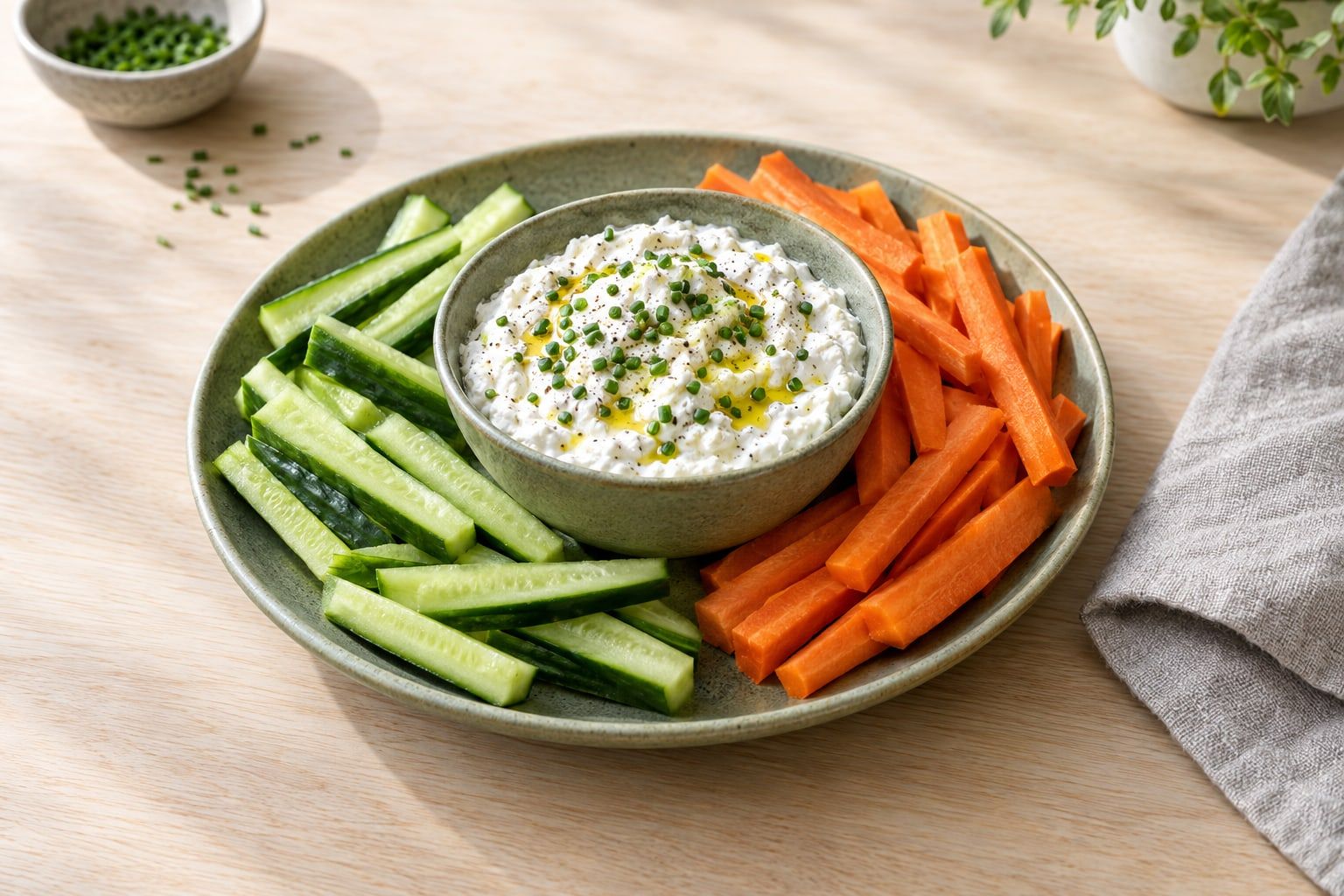
Stir once, then scatter over the remaining chives and serve.
How to tell it's done
- The dip is completely smooth, with no visible curds, and thick enough to hold a ridge when you drag a spoon through it.
- It tastes bright from the lemon and garlic without any one flavour taking over.
Tips for success
- Blend for a full minute
Cottage cheese curds break down slowly. Keep the blender running for 60–90 seconds and scrape the sides down halfway, so the dip turns smooth rather than grainy.
- Taste before adding salt
Cottage cheese already contains about 0.5 g salt per 100 g, so the dip rarely needs more. Taste after the chives and lemon go in, and add a twist of pepper instead.
- Chill it before serving
Thirty minutes in the fridge lets the garlic and chives flavour the dip and thickens it slightly. Stir it once before serving, as a little liquid can collect on top.
Boost the protein
- Blend in 100 g quark with the cottage cheese in step 2: +4 g protein per portion.
- Blend in 20 g finely grated parmesan: about +2 g protein per portion (not vegetarian).
Choosing ingredients
Choose plain reduced fat cottage cheese with small curds, which blends fastest. Check the label for salt and avoid flavoured tubs.
Use strained 0% fat Greek yogurt, not a thin Greek-style one, so the dip stays thick and the protein stays high.
Variations
- Chunky dip
Blend only 250 g of the cottage cheese with the yogurt, garlic, lemon and oil, then fold in the remaining 150 g by hand. Protein is unchanged.
- Herb dip
Add 15 g chopped parsley and 1 tbsp chopped dill with the chives in step 3. Protein is the same as the original.
- Hot chilli dip
Stir 1 tbsp hot chilli sauce into the finished dip in step 3 and skip the black pepper. Protein is the same.
Serve it with
- Cucumber, carrot and pepper sticks
- Warm high protein pitta
- Wholegrain crackers
Storage
The cottage cheese dip keeps for 3 days in the fridge in a lidded container. Stir it before serving, since a little liquid collects on top as it stands.
It does not freeze well, as the texture turns grainy once it thaws.
Troubleshooting
Why is my cottage cheese dip grainy?
The curds were not blended for long enough. Keep the blender running for a full 90 seconds, scrape down the sides and blend again until no small curds are left.
Why is my cottage cheese dip watery?
Cottage cheese releases liquid, and the extra water thins the dip. Drain the cottage cheese in a sieve for 5 minutes before blending next time, or stir in 2 tablespoons of strained Greek yogurt.
Frequently asked questions
How much protein is in this cottage cheese dip?
Each of the four portions, about 120 g, has 12 g protein and 88 kcal, so 55% of the energy comes from protein. Almost all of it comes from the cottage cheese.
Can I make cottage cheese dip without a blender?
A blender gives the smoothest result, but you can push the cottage cheese through a fine sieve with the back of a spoon. It is slower, and the dip will be slightly looser.
How long does homemade cottage cheese dip last?
The dip keeps for 3 days in the fridge. Stir it before serving, and discard it if it smells sour or looks off.
Made it? Rate the recipe
Read next
- Protein in Cottage CheeseProtein in cottage cheese: 150 g plain has 14.1 g protein and 155 kcal, reduced fat has 15.9 g and 102 kcal. Values per 100 g, per portion and per tub.
- Highest Protein CheeseProtein in cheese per 100 g and per portion: Parmesan has 36.2 g, half-fat Cheddar 32.7 g and feta 15.6 g. Ranked by protein and per 100 kcal.
Written by The Protein Recipes editorial team. Nutrition is calculated from the ingredient list using CoFID. Read how our recipes are made and how we correct mistakes.