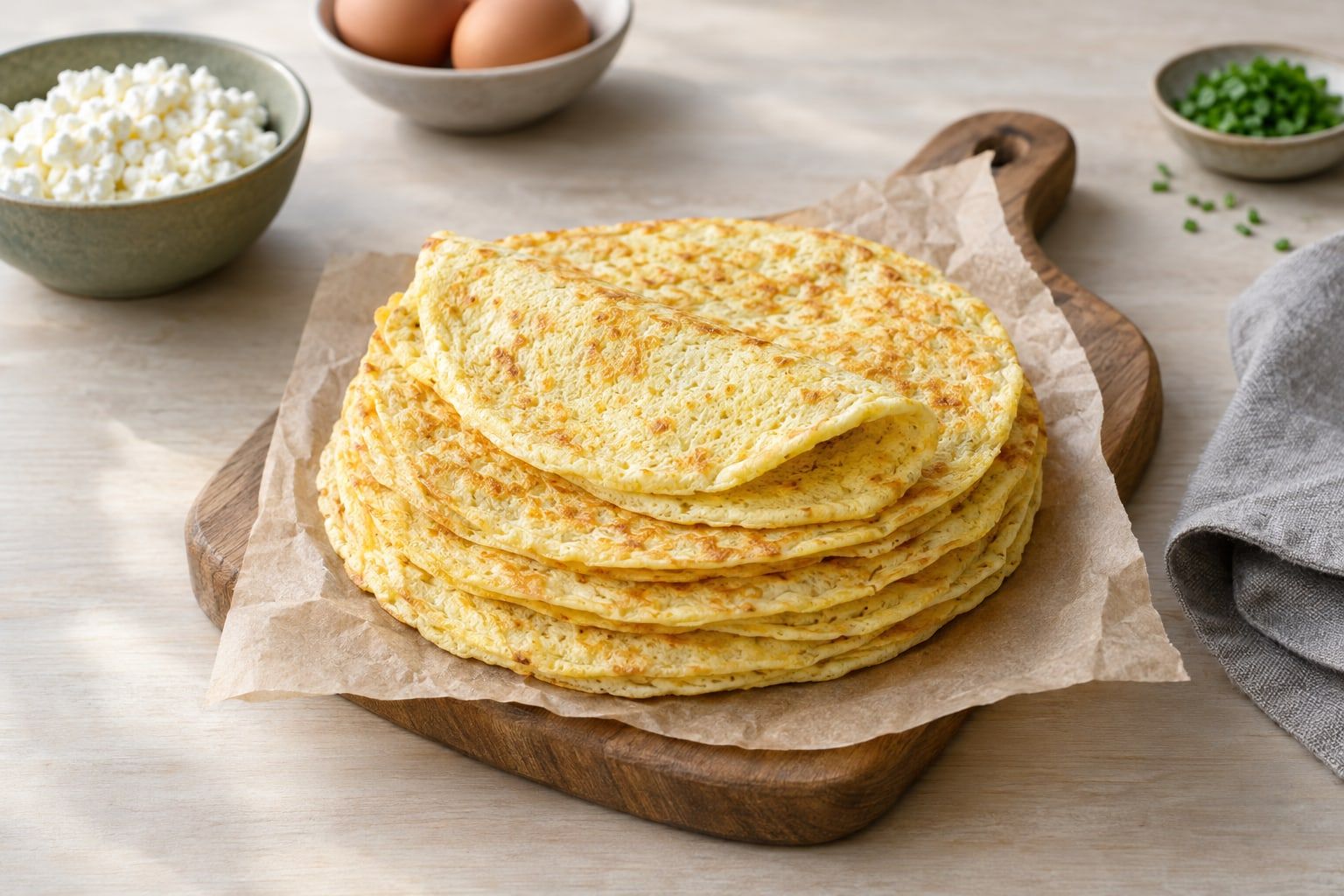
Method
Tap a time to start a timer.
Heat the oven to 180°C (160°C fan), gas 4. Line a large baking tray with baking parchment.
Put the cottage cheese, eggs, garlic powder and salt in a blender and blend until completely smooth.
Pour the batter onto the lined tray and spread it with a spatula to a thin, even layer about 4 mm thick, almost to the edges of the tray.
Bake on the middle shelf until the wrap is set in the centre and pale golden on top.
Leave the wrap on the tray for 3 minutes, then cut it into 4 pieces. Peel each wrap off the parchment.
Fill each wrap, fold or roll it, and eat straight away.
How to tell it's done
- The wrap is firm and set in the centre, with no wobble or wet patches when you shake the tray.
- The surface is pale gold, not brown, and the edge lifts cleanly from the parchment.
Tips for success
- Spread the batter to 4 mm
450 g of batter spread over most of a 30 × 40 cm tray comes out at about 4 mm. A thicker layer bakes into a soft omelette sheet that cracks when you fold it.
- Take it out when it is set, not brown
The wrap is ready when the centre is set and the surface is pale gold. Extra time dries it out so it splits instead of bending.
- Fill the wraps straight away
Warm wraps are the most flexible. If you are not filling them at once, cover them with a sheet of kitchen paper or a clean tea towel so the surface does not dry.
Boost the protein
- Fill each wrap with 40 g sliced cooked chicken breast: +13 g protein per wrap.
- Blend 15 g whey protein powder into the batter in step 2: +3 g protein per wrap.
Choosing ingredients
Use reduced fat plain cottage cheese, which has 10.6 g protein per 100 g. A 300 g tub gives you the 250 g you need with a little left over.
Medium eggs weigh about 50 g without the shell, and four give the 200 g in the list. If you only have large eggs (about 58 g each), use 3 and add 25 g more cottage cheese.
Variations
- With herbs
Add 1 tbsp chopped chives or parsley to the batter in step 2. Bake time stays the same.
- Thicker flatbreads
Spread the batter into a 20 × 30 cm rectangle on the tray, about 7–8 mm thick, and bake for 22–25 minutes until set. Cut into 4 for softer, thicker flatbreads.
- Wraps for a roll-up lunch
Fill with sliced chicken, cucumber and lettuce, roll up tightly and wrap in cling film for the lunchbox.
Serve it with
- Sliced chicken, lettuce and cucumber filling
- Hummus and grated carrot
- Tomato and cucumber salad
Storage
Keep the cooled wraps in the fridge for up to 3 days with a sheet of baking parchment between each wrap, in an airtight container.
Warm each wrap for 15 seconds in the microwave to make it flexible again before filling.
Troubleshooting
Why does my cottage cheese wrap tear when I fold it?
The sheet was too thick or baked too long. Spread the batter to about 4 mm and take it out as soon as the centre is set, then fill and fold while it is still warm.
Why is my cottage cheese wrap rubbery?
The batter was spread too thickly, so the middle took longer and the outside overcooked. Aim for 4 mm and check from 15 minutes.
Why is my cottage cheese wrap wet in the middle?
The wrap needed longer in the oven or the layer was too thick. Return it to the oven for 2–3 minutes and check the centre is firm before you lift it.
Frequently asked questions
How much protein is in a cottage cheese wrap?
Each of the 4 wraps has 13 g protein and 110 kcal, so 48% of the energy comes from protein. The filling adds more, for example 40 g sliced cooked chicken adds about 13 g.
Is a cottage cheese wrap the same as a wrap with cottage cheese inside?
No. This is a wrap made from cottage cheese and egg, baked in a thin sheet and used like a tortilla. You can also fill any wrap with cottage cheese, but that is a different recipe.
Are cottage cheese wraps gluten-free?
The wrap itself contains no wheat flour, so it is gluten-free. Check the garlic powder label, and use gluten-free fillings.
Can you freeze cottage cheese wraps?
They keep best in the fridge, where they last 3 days. Freezing can leave the texture watery after defrosting, so make a fresh batch instead.
Made it? Rate the recipe
Read next
- Protein in Cottage CheeseProtein in cottage cheese: 150 g plain has 14.1 g protein and 155 kcal, reduced fat has 15.9 g and 102 kcal. Values per 100 g, per portion and per tub.
- Protein in BreadProtein in bread: a slice has 2.8–4.0 g protein depending on type and weight. Wholemeal, white, seeded, bagels, pitta and tortillas compared.
- Highest Protein CheeseProtein in cheese per 100 g and per portion: Parmesan has 36.2 g, half-fat Cheddar 32.7 g and feta 15.6 g. Ranked by protein and per 100 kcal.
Written by The Protein Recipes editorial team. Nutrition is calculated from the ingredient list using CoFID. Read how our recipes are made and how we correct mistakes.