Protein guide
Can You Eat Too Much Protein?
Quick answer
There is no fixed upper limit, but UK advice for adults has been not to eat more than twice the reference intake of 0.75 g per kg a day. For a 75 kg adult that is about 112 g protein.

Too much protein is not marked by a single fixed upper limit, but UK advice for adults has been not to eat more than twice the Reference Nutrient Intake of 0.75 g per kg of body weight a day. For a 75 kg adult that is about 56 g as the reference and about 112 g as the ceiling, and for 60 kg it is 45 g and 90 g.
The European Food Safety Authority sets its own reference at 0.83 g per kg and found too little data to set a tolerable upper intake level, though it considers twice the reference safe for adults. The British Nutrition Foundation says protein the body does not need is used for energy, which makes the practical effect of eating more a matter of calories. Active people are covered by research ranges of 1.2 g to 2.0 g per kg, which are not recommendations.
A high protein day is easy to build, because 150 g raw chicken, 250 g quark, a scoop of whey and two eggs come to 107.6 g before any other food. Work out your own figure, count what you eat for a few days and, if you have kidney disease, are pregnant or take regular medication, speak to your GP or a registered dietitian first.
| Body weight | UK RNI (0.75 g/kg) | Twice the RNI | EFSA PRI (0.83 g/kg) | Twice the PRI |
|---|---|---|---|---|
| 60 kg | 45.0 g | 90.0 g | 49.8 g | 99.6 g |
| 70 kg | 52.5 g | 105.0 g | 58.1 g | 116.2 g |
| 75 kg | 56.3 g | 112.5 g | 62.3 g | 124.5 g |
| 90 kg | 67.5 g | 135.0 g | 74.7 g | 149.4 g |
Source: Calculated from the UK Reference Nutrient Intake of 0.75 g protein per kg body weight per day (COMA, 1991) and the EFSA Population Reference Intake of 0.83 g per kg per day
| Food | Weight | Protein | Energy |
|---|---|---|---|
| Chicken breast fillet, raw (typical value) | 150 g | 36.0 g | 159 kcal |
| Quark | 250 g | 36.5 g | 185 kcal |
| Whey protein powder (typical value) | 30 g | 22.5 g | 114 kcal |
| Whole eggs, raw, 2 medium | about 100 g | 12.6 g | 131 kcal |
| Total | 107.6 g | 589 kcal |
Source: Calculated from CoFID values for quark and whole egg (codes 12-174, 12-937) and typical values for chicken breast and whey powder (x10, x1); medium eggs are about 50 g each without the shell
How much protein is too much?
No single number marks the point. The UK Reference Nutrient Intake for adults is 0.75 g protein per kg of body weight a day, and the Department of Health has advised adults not to eat more than twice that. For a 75 kg adult that is about 56 g as the reference and about 112 g as the ceiling. For a 60 kg adult the figures are 45 g and 90 g. The European Food Safety Authority found too little data to set a tolerable upper intake level, but considers twice its reference intake safe for adults.
What do the reference figures mean for different body weights?
The table above turns the per kg figures into grams. A 70 kg adult has a UK reference of 52.5 g and a ceiling of 105.0 g, and an EFSA reference of 58.1 g. Research on active people, cited by the British Nutrition Foundation from the American College of Sports Medicine, suggests 1.2 g to 2.0 g per kg a day, which is 84 g to 140 g at 70 kg. The top of that range is above twice the UK reference, so people who train hard may want advice from a registered dietitian.
What happens to extra protein in the body?
The British Nutrition Foundation explains that protein beyond what the body needs is used for energy. Eating more than you need therefore adds calories, which count towards your total for the day like any other food. This is a plain description of how energy works rather than a warning. It also explains why protein powders and high protein foods still need to fit inside your usual calorie intake.
How easy is it to reach 100 g of protein a day?
Easier than most people expect. 150 g of raw chicken breast gives 36.0 g, 250 g of quark 36.5 g, one scoop of whey 22.5 g and two medium eggs 12.6 g. Those four items alone total 107.6 g protein and 589 kcal. Bread, milk, rice and vegetables over the rest of the day would add more, so a day built this way could reach the ceiling for a 75 kg adult. Counting your usual day for a few days shows where you already stand.
Who should check with a professional first?
The figures on this page are general ones for healthy adults. If you have kidney disease, are pregnant or breastfeeding, take regular medication or follow a medically prescribed diet, speak to your GP or a registered dietitian about how much protein suits you. They can look at your own health, weight and activity, which no table can do. The same applies if you are considering a very high protein diet, or one that relies mainly on powders.
Practical tips
- Work out your own figure
Multiply your weight in kg by 0.75 for the UK reference and by 1.5 for twice that. For 75 kg this gives about 56 g and 112 g.
- Count the whole day
Add protein from meals, dairy and snacks before you add a shake. Most people already eat more protein than they realise.
- Spread it across meals
A protein food at each meal is easier to plan than one large serving, and keeps the total close to your target.
Myth or fact
- Myth
Is it true that the UK has a fixed upper limit for protein?
No. There is no fixed upper limit. UK advice has been not to exceed twice the Reference Nutrient Intake, and EFSA found too little data to set a tolerable upper intake level for adults.
- Myth
Is it true that the extra protein you eat is turned into more muscle?
No. The body uses the protein it needs and the British Nutrition Foundation says the rest is used for energy. Extra protein adds calories rather than being kept as spare protein.
Frequently asked questions
How much protein is too much in a day?
There is no fixed limit. UK advice has been not to exceed twice the Reference Nutrient Intake of 0.75 g per kg, which is about 112 g for a 75 kg adult and 90 g for a 60 kg adult.
What happens if you eat too much protein?
The body uses what it needs and the rest is used for energy, according to the British Nutrition Foundation. The extra calories count towards your daily total.
Is 150 g of protein a day too much?
It is above twice the UK reference for adults up to 90 kg, where the ceiling is 112 g at 75 kg and 135 g at 90 kg. Active people may be advised higher figures, so speak to a registered dietitian.
Can too much protein harm your kidneys?
If you have kidney disease or any kidney concern, speak to your GP or a registered dietitian about how much protein suits you. This page gives general figures for healthy adults.
How do I check how much protein I eat?
Weigh your usual foods for a few days and use per 100 g values. For example, 150 g of raw chicken gives 36.0 g, 250 g of quark 36.5 g and two medium eggs 12.6 g.
Recipes to try

Protein Overnight Oats
26 g protein334 kcal8 hr 5 minVegetarian
A breakfast that adds protein without going over a sensible daily total.

Cottage Cheese and Egg Bake
22 g protein190 kcal55 minVegetarianGluten-free
A bake that cuts into set portions, which makes counting easy.
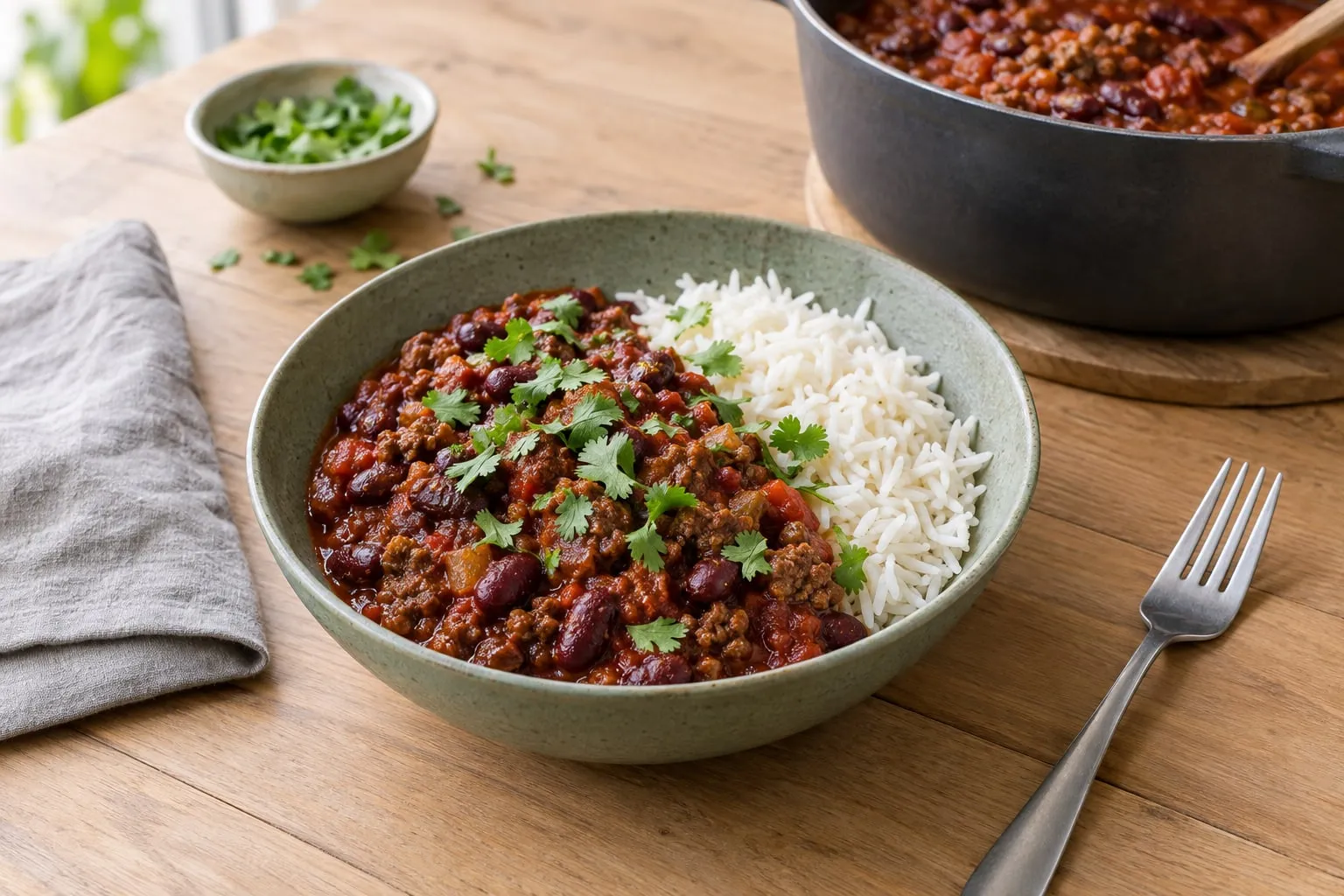
High Protein Chilli con Carne
33 g protein287 kcal1 hr 25 minGluten-freeDairy-free
A batch-cooked dinner with the protein shared across several servings.

Protein Smoothie
32 g protein387 kcal5 minVegetarian
A blended option with the numbers worked out per glass.

Sources
- British Nutrition Foundation – Protein information page: Reference Nutrient Intake of 0.75 g per kg, advice not to exceed twice the RNI, and sports guidance citing the American College of Sports Medicine
- European Food Safety Authority (EFSA) – Scientific opinion on dietary reference values for protein: Population Reference Intake of 0.83 g per kg and no tolerable upper intake level
- McCance and Widdowson's Composition of Foods Integrated Dataset 2021 (CoFID) – Values for quark and whole egg
Read our editorial policy for how figures are checked and how to report a mistake.
More protein guides
All guides
Guide
How Much Protein Do You Need Per Day?
How much protein do I need? The UK reference is 0.75 g per kg of body weight a day, or 52.5 g at 70 kg. See food values and a worked example day.

Guide
How Much Protein to Build Muscle
How much protein to build muscle: research on regular training suggests 1.2–1.6 g per kg a day, 84–112 g at 70 kg, against 53 g for the UK reference intake.
Guide
High Protein Foods: A Ranked List
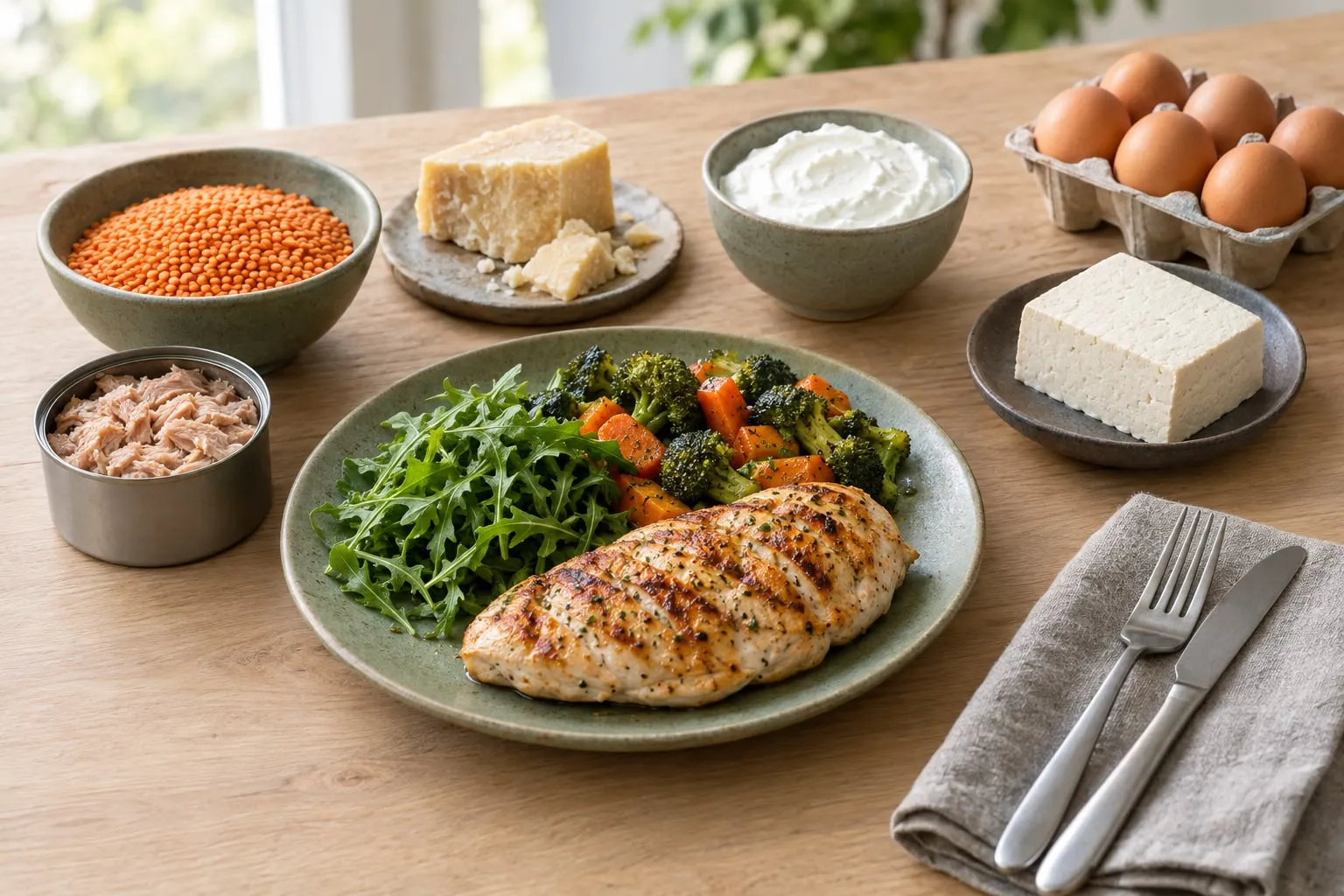
High protein foods ranked by protein per 100 g and per 100 kcal: Parmesan has 36.2 g, grilled chicken 32.0 g, dried red lentils 25.6 g and egg white 10.8 g.
Guide
Protein Calculator
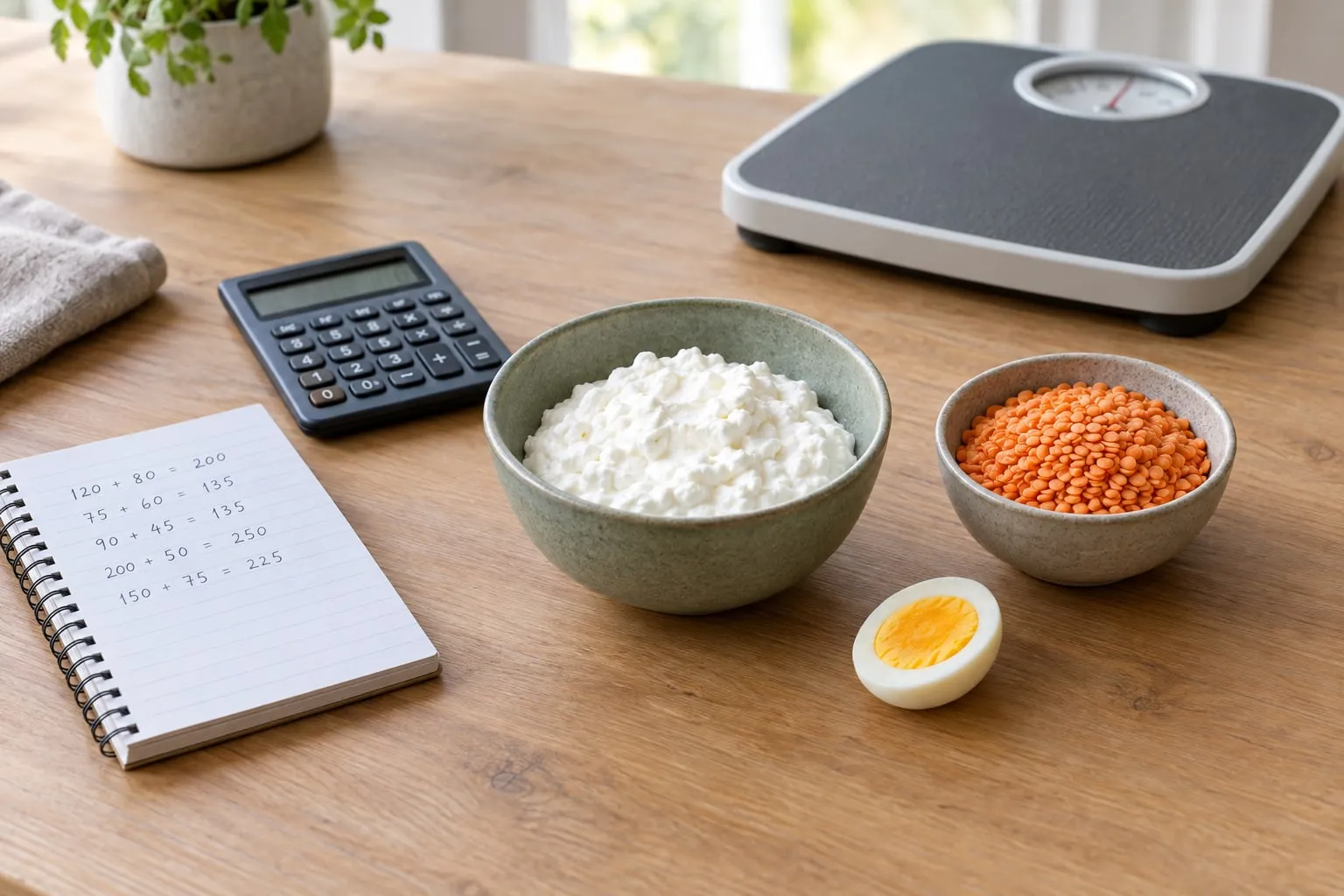
Protein calculator: multiply your weight in kg by 0.75 for the UK reference amount, so 70 kg gives 53 g a day. Tables for kg and stone, plus foods per 20 g.