Method
Tap a time to start a timer.
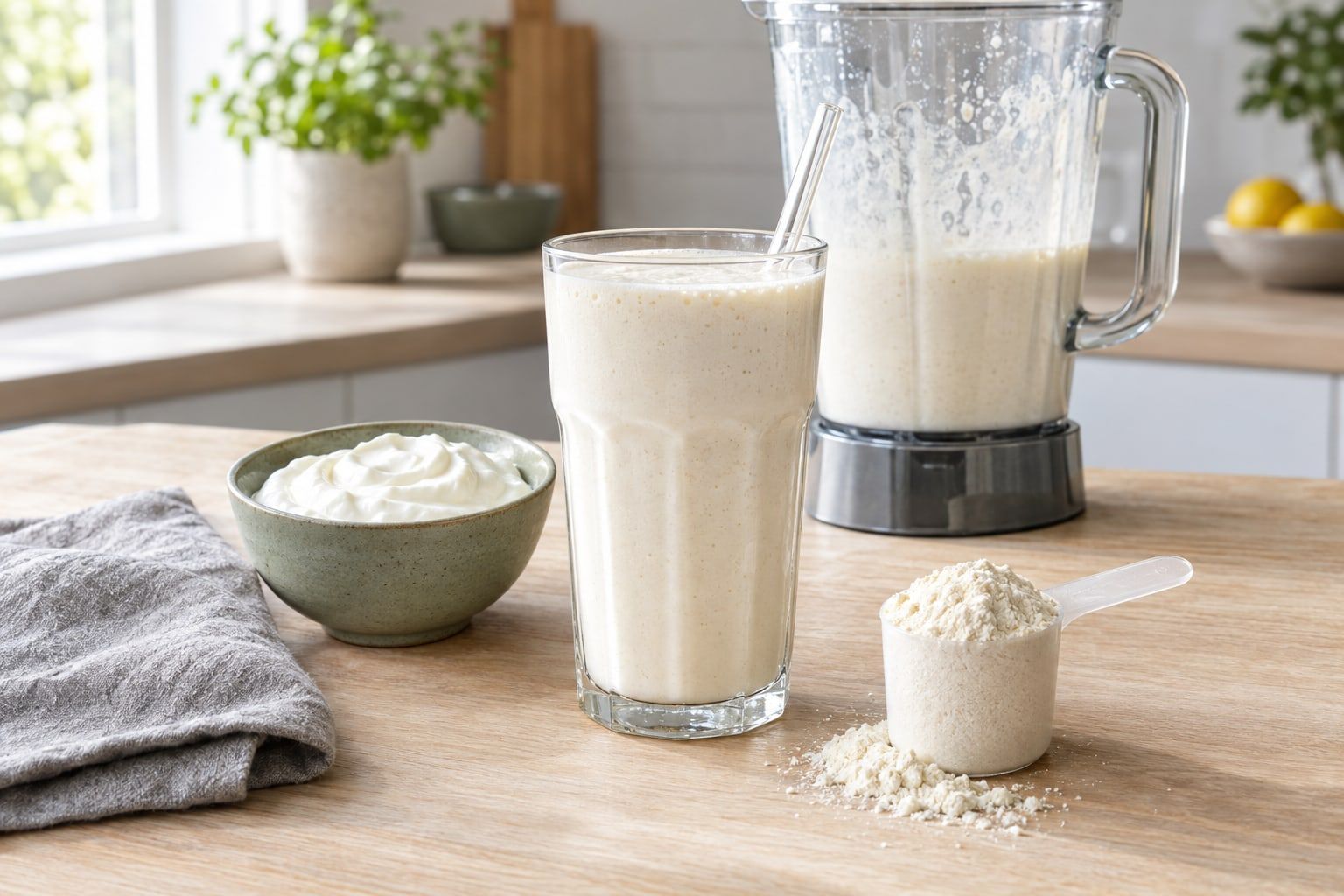
Pour the semi-skimmed milk into the blender jug and spoon in the Greek yogurt.
Add the whey protein powder.
Blend on high until smooth, with no powder clinging to the sides of the jug.
Pour into a tall glass or a 500–600 ml shaker bottle and drink straight away.
How to tell it's done
- The shake is smooth and pours easily, with no dry powder or lumps of yogurt.
- It has settled a little after blending, with the foam on top only 1–2 cm deep.
Tips for success
- Pour the liquids in first
Milk and yogurt go into the jug before the powder. The whey then lands in liquid rather than packing against the blades, and the shake blends without dry clumps.
- Use cold milk
Whey foams when it is blended. Milk straight from the fridge gives a cold shake without ice, which would take up room in a glass that already holds about 500 ml.
- Weigh the powder
A scoop varies from 25 g to 40 g between brands. Weigh 40 g once and mark the level in your own scoop, because the 51 g protein figure depends on 40 g of powder.
Boost the protein
- Swap the 100 g strained Greek yogurt for 100 g quark: +4 g protein per glass.
- Add 100 g extra strained Greek yogurt and blend in a larger jug: +10 g protein per glass, with the volume rising to about 600 ml.
Choosing ingredients
Pick a whey with at least 75 g protein per 100 g, as in this recipe. A whey with 60–65 g per 100 g gives about 5 g less from 40 g.
Strained Greek yogurt labelled 0% fat has about 10 g protein per 100 g. Greek-style yogurt that is not strained has much less.
Variations
- Pea and rice protein version
Use 55 g pea and rice protein powder in place of the whey. It is grainier and thicker, so add 50 ml water if needed. Protein is about 62 g per glass.
- Chocolate version
Add 1 tsp cocoa powder (about 5 g) in step 2 and blend as before. Protein rises to about 52 g per glass.
Serve it with
- A banana
- A slice of wholemeal toast
- A handful of berries
Storage
Drink the shake straight away, or keep it in a sealed bottle in the fridge for up to 24 hours and shake well before drinking.
Do not freeze it in the glass. Pour it into ice cube trays instead and blend the cubes with a splash of milk.
Troubleshooting
Why is the 50g protein shake thick and foamy?
Whey foams when it is blended hard. Let the shake stand for 2 minutes after blending, or blend for 20 seconds rather than 30 and add 50 ml extra milk.
Why is the 50g protein shake gritty?
The powder was not fully blended, or it is a plant-based powder, which is naturally grainier. Blend for a further 20 seconds and add 50 ml milk to thin it.
Frequently asked questions
How much protein is in this 50g protein shake?
One glass has 51 g protein and 344 kcal, so 59% of the energy comes from protein. Of the protein, 30 g comes from the whey, 11 g from the milk and 10 g from the Greek yogurt.
Is 50g of protein in one shake too much?
There is no single limit that applies to everyone. There is no proven cut-off for a single meal, and protein from one sitting counts towards the day's total. The reference intake used on UK food labels is 50 g a day for adults, so this shake is a large share of it. If you have kidney disease or a medical condition, speak to your GP or a registered dietitian.
Is this a 50g protein drink without powder?
Without the whey the shake has about 21 g protein. To reach 50 g without powder you would need roughly 500 g strained Greek yogurt or 340 g quark in one sitting, which is a meal rather than a drink.
Does the 50g protein shake work as a snack?
Yes. At 344 kcal it is the size of a small meal, and with 51 g protein it works as a snack after training or as a light breakfast.
Made it? Rate the recipe
Read next
- How Much Protein Is in Milk?Protein in milk: semi-skimmed has 3.5 g per 100 g, so a 200 ml glass gives 7.0 g and a pint 19.9 g. Whole, skimmed, goat's and plant drinks compared.
- Do Protein Shakes Help You Lose Weight?Protein shake for weight loss: a shake adds calories like any food. 30 g whey with water has 22.5 g protein and 114 kcal, with semi-skimmed milk 229 kcal.
Written by The Protein Recipes editorial team. Nutrition is calculated from the ingredient list using CoFID. Read how our recipes are made and how we correct mistakes.