Method
Tap a time to start a timer.
Heat the oven to 150°C (130°C fan), gas 2. Line the baking tray with baking paper.
Mix the oats, almonds, sunflower seeds, cinnamon and salt in the large bowl.
Whisk the whey, egg white, maple syrup, rapeseed oil and water in the medium bowl until smooth. It will be thick, like a loose paste.
Scrape the binder over the oat mixture and stir until every oat is coated. Tip onto the tray, spread to an even layer and press down firmly.
Bake for 15 minutes, then turn the granola in large pieces with a spatula and press it flat again.
Bake for a further 10–15 minutes until golden at the edges and dry on top.
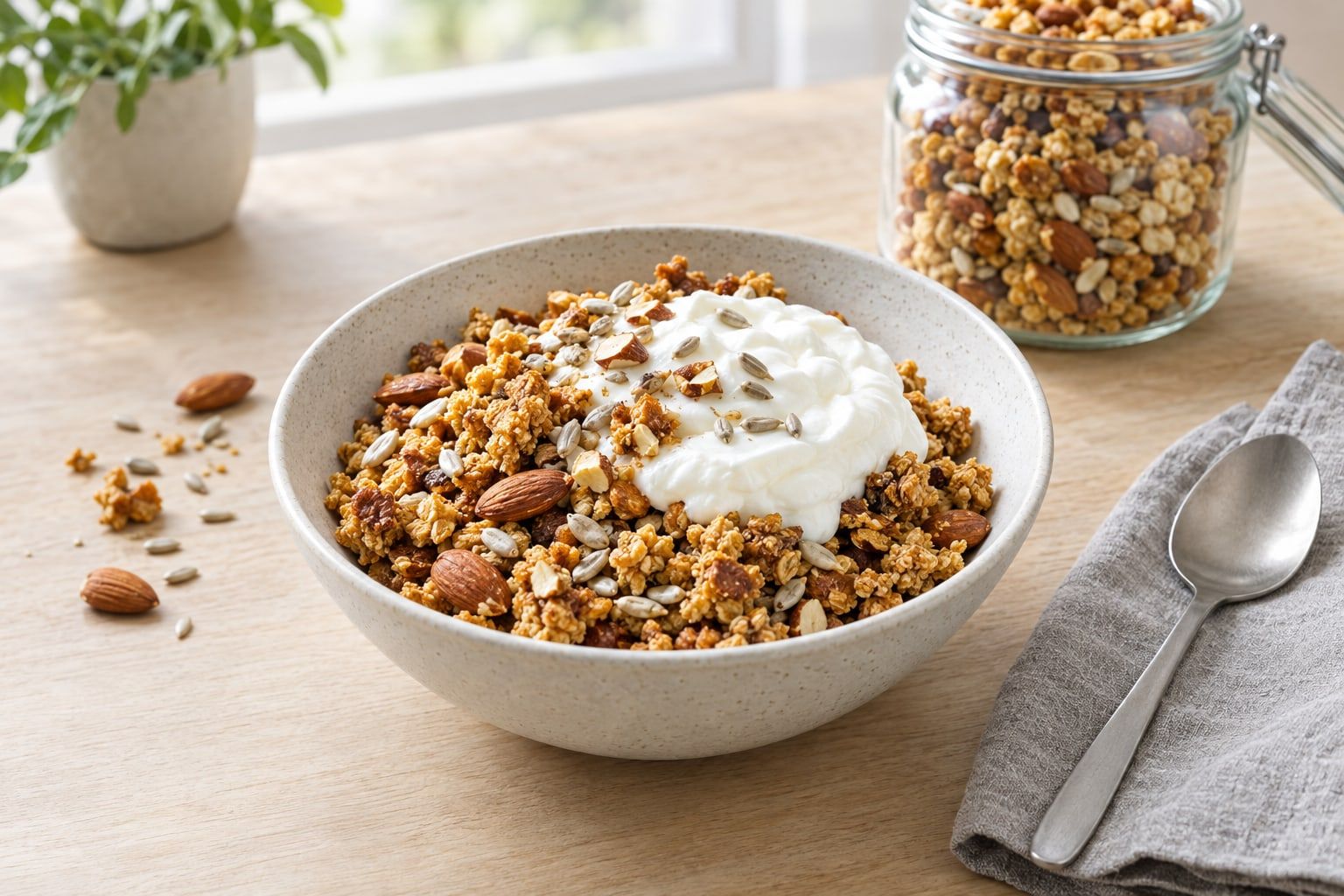
Leave to cool completely on the tray, then break into clusters and store in the jar. Serve 50 g granola on 150 g Greek yogurt per bowl.
30 min cooling
How to tell it's done
- The granola is golden at the edges and looks dry on the surface, with no damp patches.
- After 30 minutes of cooling it is crisp and breaks into clusters, with no chewy, soft pieces.
Tips for success
- Keep the oven at 150°C
Whey darkens and turns bitter at high temperatures. A low oven toasts the oats gently, and the clusters dry out without scorching.
- Stir once, then leave it alone
Turn the granola gently at the halfway point, pressing it back into a sheet. Stirring more than once breaks up the clusters, which form as the binder dries.
- Let it cool completely
The granola is soft when it comes out and crisps as it cools. Break it up only once the tray is cold to the touch, or it turns to crumbs.
- Weigh the portion
Granola is dense, at roughly 390 kcal per 100 g. A 50 g portion over strained Greek yogurt makes a bowl, and scooping by eye can double it.
Boost the protein
- Serve each bowl with 200 g strained Greek yogurt instead of 150 g: +5 g protein per bowl.
- Add 30 g more whey to the binder with 2 tablespoons of water: about +2 g protein per 50 g portion. Whey is then 120 g of 320 g whey and oats, which is 37.5% and still under 40%.
Choosing ingredients
Use liquid egg white from a carton, which is pasteurised and measures easily. It binds the clusters and bakes to a dry crunch.
Whey blends smoothest. Casein thickens the binder more, so add 2 more tablespoons of water, and vegan pea and rice powder is grainier and needs extra water too.
Variations
- Cocoa granola
Add 15 g cocoa powder to the dry mix and 1 extra tablespoon of water to the binder. The protein per portion stays about the same.
- Nut-free granola
Replace the almonds and sunflower seeds with 100 g more porridge oats. Protein falls by about 1 g per 50 g portion, and the granola is a little lighter.
Serve it with
- Strained Greek yogurt
- Fresh berries
- Cold semi-skimmed milk
Storage
Store the cooled granola in an airtight jar at room temperature for up to 3 weeks.
Keep the yogurt separate and add the granola just before eating, so it stays crisp.
Troubleshooting
Why is my high protein granola not clustering?
The binder was too thin or the granola was stirred too much. Press it firmly into one layer on the tray, turn it only once, and break it up after it has cooled.
Why does my high protein granola taste bitter?
The whey scorched. Keep the oven at 150°C (130°C fan) and check the edges from 20 minutes, taking the tray out as soon as they turn golden.
Frequently asked questions
How much protein is in granola?
Many shop-bought granolas have about 8–10 g protein per 100 g. This high protein granola has about 12 g protein per 50 g portion before the yogurt, and a bowl with 150 g strained Greek yogurt has 28 g protein and 277 kcal, so 40% of the energy comes from protein.
Can I make high protein granola without whey?
Yes, but the protein drops. Leave out the 90 g whey and the 40 ml water, and a 50 g portion has roughly 5–6 g protein. Expect a lighter, less clustered granola.
How long does homemade high protein granola keep?
It keeps for up to 3 weeks in an airtight jar at room temperature. One batch fills one tray and gives 10 bowls, so there is no need to double it.
Made it? Rate the recipe
Read next
- Protein in OatsProtein in oats: porridge oats have 10.9 g protein per 100 g dry, so a 40 g portion gives 4.4 g. Porridge made with milk or water, and ways to add more.
- How Much Protein Do You Need Per Day?How much protein do I need? The UK reference is 0.75 g per kg of body weight a day, or 52.5 g at 70 kg. See food values and a worked example day.
Written by The Protein Recipes editorial team. Nutrition is calculated from the ingredient list using CoFID. Read how our recipes are made and how we correct mistakes.