Method
Tap a time to start a timer.
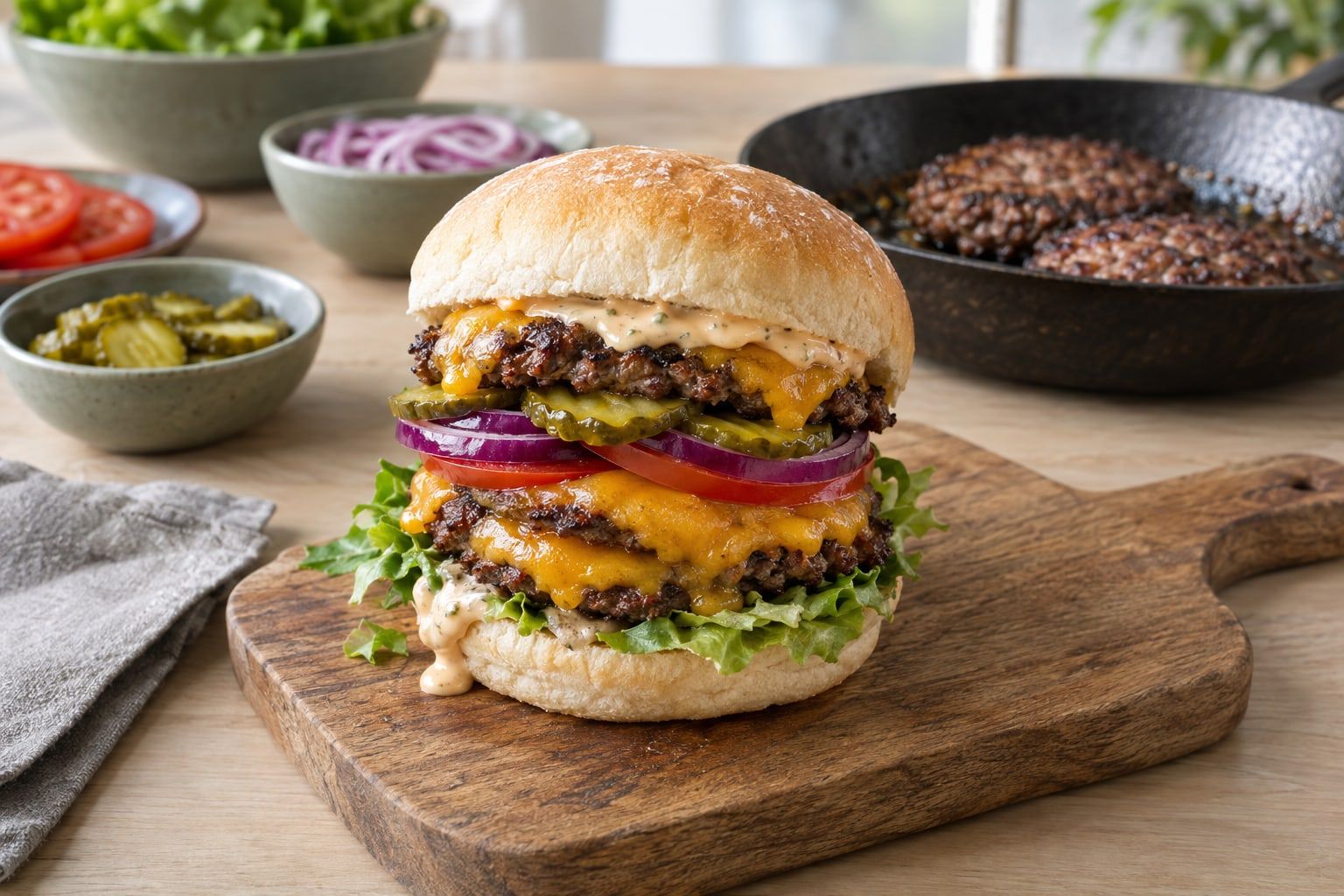
Stir the yogurt, mustard and chopped gherkins together in a small bowl. Shred the lettuce and slice the tomato and red onion. Divide the cold mince into 8 balls of 75 g and roll each lightly without kneading.
Heat the pan over the highest heat for 3 minutes until very hot. Toast the rolls cut-side down for 1 minute, then set them aside.
Brush the pan with the rapeseed oil. Add 2 balls, press each flat to about 1 cm with the fish slice for 10 seconds, and sprinkle a little of the salt over the tops. Cook without moving until the edges are dark and crisp.
Scrape under the patties, flip them and top each with half a slice of Cheddar. Cover with a lid or tray for 1 minute until the cheese melts and the patty reads 75°C in the centre.
Move the patties to a plate and keep them covered with foil. Repeat steps 3 and 4 with the remaining balls, in 4 batches in all, so that each batch of 2 patties makes one burger.
Spread the sauce over the cut sides of the rolls. Layer lettuce, tomato, onion and two patties in each roll and serve at once.
How to tell it's done
- Core temperature: 75°C in the thickest part, checked with a probe thermometer.
- The edges of each patty are dark and crisp, and the centre reads 75°C on a thermometer.
- The cheese has melted completely over the patty and no pink remains in the middle.
Tips for success
- Keep the mince cold and untouched
Divide the mince into 8 balls straight from the fridge and roll them just enough to hold together. Warm, kneaded mince turns dense and compact, while cold, loosely shaped mince gives the crisp, lacy edges.
- Salt the outside only
Scatter the salt over the patties once they are in the pan. Mixing salt through the mince pulls out moisture and makes the burgers springy, and there is already salt in the Cheddar and the rolls.
- Use 12% fat mince
The fat is what crisps the edges and keeps a 1 cm patty juicy in 3 minutes in the pan. Extra lean mince dries out and sticks to the pan at this thickness.
Boost the protein
- Add a fried egg to each burger (1 medium egg, about 50 g): about +6 g protein per burger.
- Add a second slice of half-fat Cheddar (25 g) to each burger: +8 g protein per burger.
Choosing ingredients
Look for beef mince labelled 12% fat. Anything under 10% gives a drier smashed burger, and 20% fat mince leaves a lot of fat in the pan and the roll.
Soft white bread rolls about 60 g each hold up to two patties. Seeded or wholemeal rolls add a little more fibre but are firmer to bite through.
Variations
- Thick pub-style patties
Shape 4 patties of 150 g, about 2.5 cm thick, and fry over a medium-high heat for 5–6 minutes a side until they read 75°C, then top with the Cheddar for the last minute. Each burger has one patty with a slice of Cheddar, and protein stays at about 45 g.
- Bun-free in lettuce leaves
Serve the two patties and the toppings in 2 large lettuce leaves each instead of the roll. Protein falls to about 40 g per burger.
Serve it with
- Oven chips
- Coleslaw made with Greek yogurt
- Sparkling water with lime
Storage
Cooked burger patties keep for 2 days in the fridge in a covered container. Reheat them in a hot pan until they read 75°C in the centre.
Freeze the shaped raw balls for up to 3 months, with baking paper between each, and cook from thawed.
Troubleshooting
Why are my smashed burgers dry?
The mince was probably too lean or the patties cooked past 75°C. Use 12% fat mince and take each batch off as soon as the cheese has melted.
Why do my smashed burgers stick to the pan?
The pan was not hot enough when the patties went in. Preheat it for the full 3 minutes and wait until the edges are dark before scraping, so the crust releases from the pan.
Frequently asked questions
How much protein is in this burger recipe?
Each of the four burgers has 45 g protein and 588 kcal, so 31% of the energy comes from protein. The beef gives about 30 g of it, the Cheddar 8 g and the roll 6 g.
What is a smashed burger?
A smashed burger is a ball of mince pressed flat on a very hot pan, so the surface browns into a lacy crust in 2 minutes. This smashed burger recipe makes thin patties and stacks two per roll, and the thick pub-style version is in the variants.
Can I make a beef burger recipe in the oven or on the grill?
Yes, shape the 150 g thick patties from the variants and grill them for 5–6 minutes a side, or bake them at 200°C (180°C fan), gas 6 for 15–18 minutes, until they read 75°C.
Made it? Rate the recipe
Read next
- Protein in Steak and Beef MinceHow much protein in steak: 225 g of raw lean sirloin has 52.9 g protein and 304 kcal. Steak cuts, regular and extra lean mince, raw and cooked.
- How Much Protein Do You Need Per Day?How much protein do I need? The UK reference is 0.75 g per kg of body weight a day, or 52.5 g at 70 kg. See food values and a worked example day.
Written by The Protein Recipes editorial team. Nutrition is calculated from the ingredient list using CoFID. Read how our recipes are made and how we correct mistakes.